16 items:
£75.05

Tea Growing
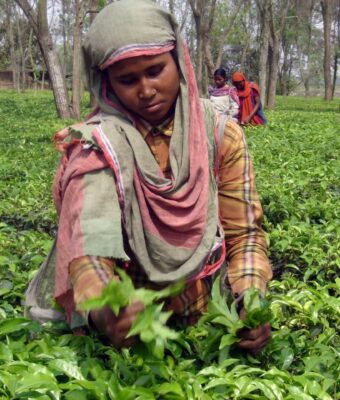
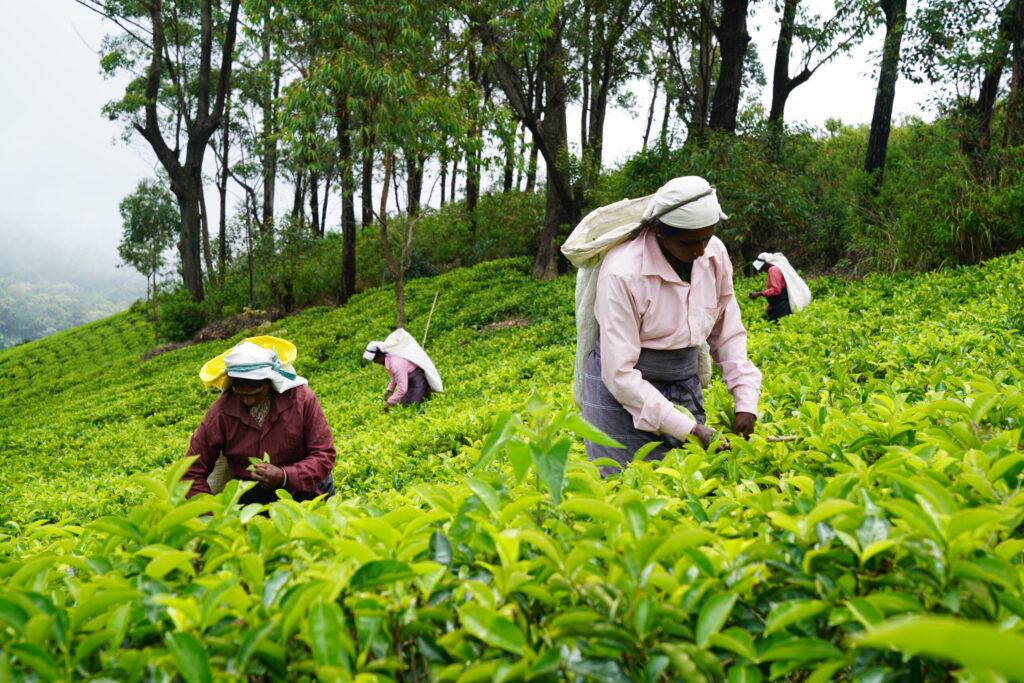
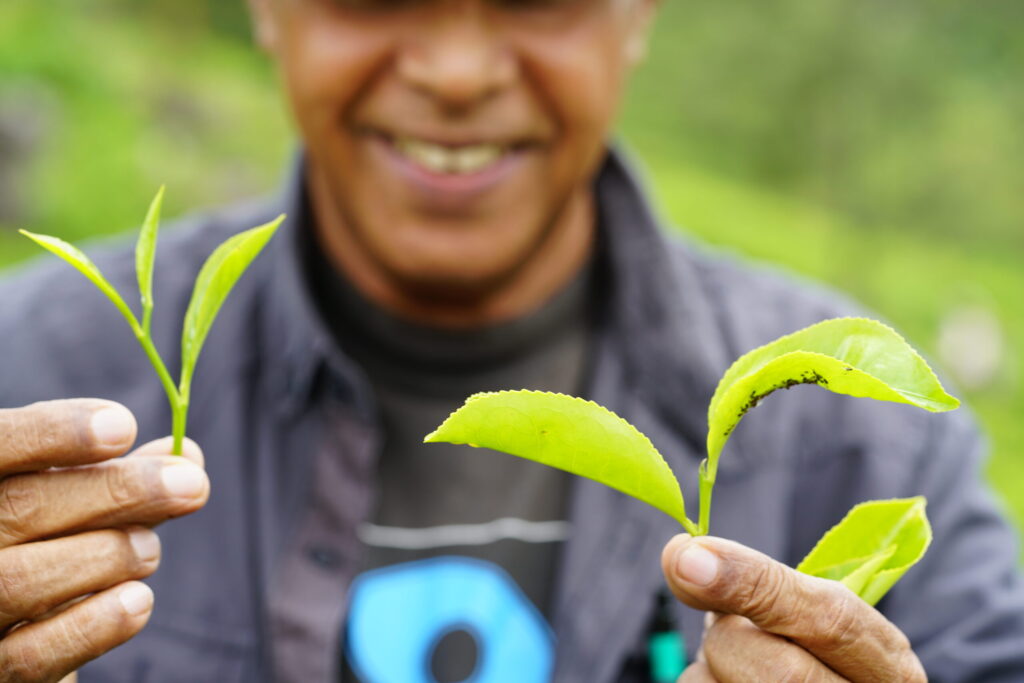
Tea begins with the bush, from the same family as the decorative Camellia. Tea bushes are evergreen and are pruned to the height of 150cm. It sends out its green tender new leaves and buds in what are called ‘flushes’, and care and attention is needed to encourage the bush to flourish and produce a quality crop.
The tea bush grows best between the latitudes of Cancer and Capricorn and at altitudes of 300m – 2100m above sea level. In the wild, tea grows best in regions that are warm and humid, with a rainfall of at least 100 cm a year.
Tea bushes like deep, light, acidic and well-drained soil. The volcanic soil often found at higher altitudes enhances quality; the best Assam, Ceylon and Darjeeling teas are high grown in the cool, fresh conditions above 1220m, while low grown varieties have to endure heavy soils and warmer weather. In a cold climate, like the Himalayas, bushes lie dormant in the winter, sprout in spring and grow throughout the summer, but in semi-tropical Sri Lanka (Ceylon) and Africa, they can be plucked all year around.
Tea Processing
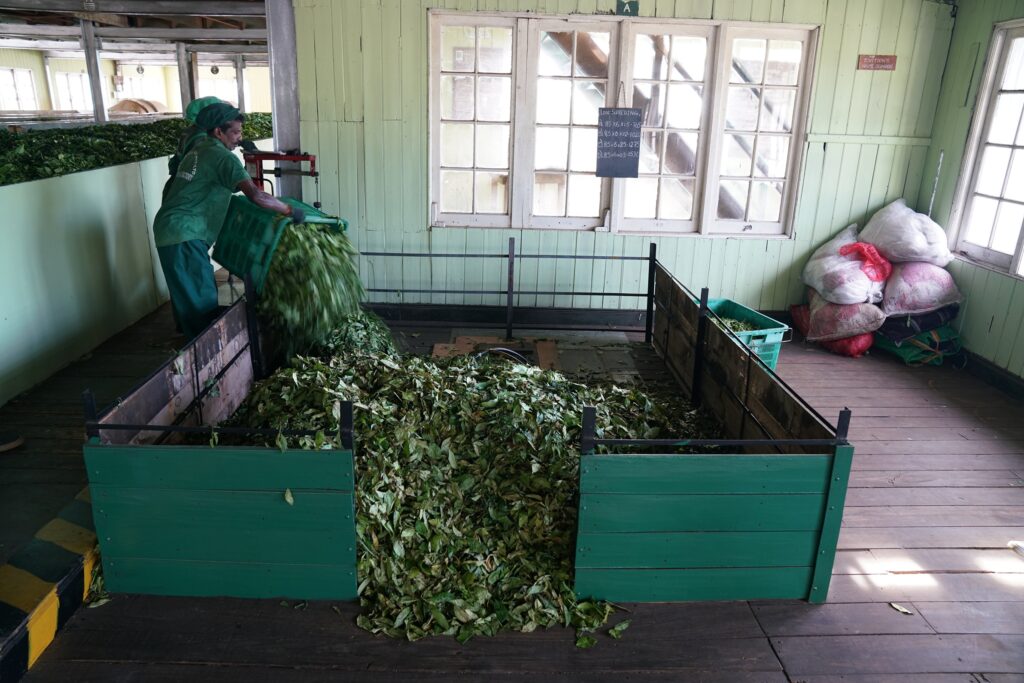
After tea leaves are picked, the first stage of processing is called withering. The fleshy green tea leaves are laid on huge trays and dried with hot air (25 – 30°C) to reduce excess moisture, which takes 10 – 16 hours. These dried tea leaves are then rolled in a large rotary drum, breaking up the leaves and releasing the natural enzymes which start fermentation (oxidisation), taking 3 – 4 hours. At this stage, the leaves start to lose their green colour, turning the more familiar coppery brown known as Orange Pekoe (or orange coloured leaf).
As the skilfully controlled fermentation process continues, it is stopped by drying before the leaves become too black and plain, then the tea leaves are rolled into tight twists and graded. There are 2 methods of processing.
The traditional method, called Orthodox Teas, keeps the look of the leaf whatever its size and is used for all China, Darjeeling and most Ceylon and about 10% of Assam teas. In the modern manufactured method, the leaf is Cut, Torn and Curled, i.e., CTC Teas, rather than rolled, producing strong black balls of tea which release a very strong flavour and colour. It is ideal for small, strong leaf teas which are needed to flow easily through packing and tea bag machines.
Green teas and oolongs are non-fermented teas, i.e., the tea leaves are picked and allowed to dry in the sun in bamboo baskets for a few hours. The tea leaves are then pan-roasted and finally rolled into attractive shapes that provide pleasure from the leaf before, during, and after the tea is brewed. These tea leaves range from bright to dull green and are pliable.
In Japan, green tea is steamed and processed into different forms, including powdered green tea or matcha, which is still used today in Japanese tea ceremonies. In Japan, there are 3 grades of green tea: bancha, sencha, and gyokuro. Bancha tea is Japan’s ordinary green tea. It comes from the late summer pickings and is somewhat coarse in flavour and appearance. Sencha is one step up and comes from the first or second flushes. The tea is steam-fired and basket-dried and finally hand-rolled. This process is more costly. Sencha gives off a grassy aroma and is pale in colour. Gyokuro tea is harvested once a year and only the bud and tiny first leaf are plucked. This process means precious dew. This tea brews to give a very pale green to yellow colour and has a clean brisk flavour.
Oolong teas are semi-fermented, partially withered and partially oxidised. China and Taiwan are the main producers of this type of tea. Leaves for oolong must be picked at exactly the right time and processed immediately afterwards. They are withered in direct sunlight, then shaken in bamboo baskets to bruise the edges of the leaves which turn a reddish-brown colour after oxidation has occurred. This process is repeated a few times. Oolong tea leaves are never broken by rolling as in green teas or by machines with black tea, and they should always be long and whole leaves.


TEAS FROM AROUND THE WORLD
Indian Teas
India is the world’s largest producer of tea, but most is drunk in the local market, with Sri Lanka being the largest exporter. Most of the quality tea from Assam and Darjeeling is exported to Europe (especially Germany) and Japan.
Assam
The turbulent Brahmaputra River runs through Assam. This is where Indian tea was born – Robert Bruce found the tea plant growing wild here in 1823. Assam is naturally gifted. A tropical climate, and fertile alluvial soil, makes it ideal for tea cultivation. When Assam tea first appeared, picked from China Jat grown in Bengal, north of Calcutta, it was affected by the soil and growing conditions and tasted entirely different from the China tea people in Europe were used to. Soon afterwards, tea from newly discovered Assam Jat took over.
The new Empire Tea was altogether more robust with a heavy malty character and a rich dark liquor. These days the best large tea leaf Special Finest Tippy Orange Pekoe tea is only produced on a few tea estates. The more common leaf tea is Golden Broken Orange Pekoe grade, a neat square dark brown leaf with a pale tip, which is good and strong with a flinty, light malty character. Broken Orange Pekoe tea is most generally available as a popular, strong, everyday brew.
The Assam tea season starts in March with a small quantity of First Flush, which is green and astringent. The Second Flush begins at the end of April and lasts until the August monsoon season. Late season Autumnal tea is good about one year in every four, the rest of the time it is rather brown. Assam is a solid, strong organic tea and should be made with care – too powerful a brew can fur up one’s teeth.
The smaller grades – blacker leafed, neater Orange Pekoe Tea Fannings – are perfect for the notorious Builders Tea, Workman’s Brew or simply a Cuppa, in which you can stand your spoon. Sadly, for the pure tea lover, much of Assam’s production is targeted to CTC production for tea bags and the local marketplace, where it provides wonderful strength and fullness but always in a blend.
Darjeeling
Darjeeling, nestling in the foothills of the Himalayas, produces a high-grown tea that benefits from steady rainfall, light soil and the cool atmosphere of the hills. This tea has an aroma all its own. A mysterious mix of the mountain peaks, soft Himalayan soil and the misty air that the tea leaves breathe.
A good standard tea fetches twice the price of any other and for the best Second Flush Darjeeling Tea the sky is the limit. In our opinion, Darjeeling is simply the best tea in the world. It has everything the tea drinker wants and a heavenly, luxurious flavour as well. Some of the older estates still have areas of China Jat, cuttings from bushes which must have been planted 150 years ago, and which still retain a heady sweetness.
Dramatic seasonal changes show up in the taste: First Flush Darjeeling tea appears as soon as the snow melts, and in some areas the rush is on to pick the tender new shoots as early as February. The flavour of the First Flush tea is light and subtle, because the world-famous Darjeeling tea taste has not yet been fully developed. Main crop Darjeeling tea, picked from April onwards, has unbeatable taste. The best of these Second Flush Teas has the classic flavour of muscatel – an almost meadowy fragrance of newly mown fresh hay.
We prefer these Second Flush teas to the (usually) more highly valued First Flush teas – they just have more flavour together with the fragrance of blackcurrant or mango sneaking through. But that’s totally a personal taste rather than anything absolute.
Towards the end of the season, in October and November, the Autumnal teas can be fruity and mellow.
Darjeeling tea is a relatively scarce and flavoursome tea and so, like a great Bordeaux wine, is expensive. It is a false economy to buy a cheap leaf or a blended Darjeeling tea; you wouldn’t buy a cheap champagne or an imitation designer suit, so you should buy the best and enjoy the luxury of it.
Whatever its grade, Darjeeling tea would never be termed strong. The best are grandly titled Special Finest Tippy Golden Flowery Orange Pekoe grade; a large leaf Darjeeling tea, manufactured in the orthodox way with plenty of pale tip and the remaining leaf green or brown in colour. Nor should it be made strong: 2 teaspoons of Darjeeling tea per 6 cup pot with 5 minutes to brew. Overbrewing will bring out the astringency of the green leaf. Standard FOP tea can be drunk with milk, but the fancy grades are better drunk lightly brewed.
Sri Lankan Teas (Ceylon Teas)
The southwestern highlands of Sri Lanka offer the perfect growing conditions for tea, with each side of the range benefiting from the annual monsoon at different times of the year. As there is no real winter, tea picking is continuous, which means less tip from new spring growth. Orange Pekoe accounts for less than 2% of production and is medium grown at 610 m – 910 m (2000 ft – 3000 ft). These leaves are up to 20 mm long and have a clean, smooth and almost oaky flavour. 80% of Ceylon teas are BOP and BOPF, noticeably smaller than similar grades of Assam tea, but clean, neat and dust-free, with less tannin.
Kandy
The rolling hillsides south of the historic town of Kandy are covered with tea. At 610 m – 910 m (2000 ft – 3000 ft) in altitude, Kandy teas are classic medium-grown, producing a delicious smooth brew with good colour and strength.
Nuwara Eliya
70 km from Kandy, nestling between peaks of up to 9000 ft, are the valley and town of Nuwara Eliya (pronounced nuraylia). This is one of the most beautiful tea-growing areas – tea gardens cling to the steep slopes and are irrigated by mountain streams. It produces what is known locally as ‘the Champagne of Ceylon Teas’ with great flavour and a light, clean style. The liquor is not as dark as Kandy or as coppery as Dimbula, but the teas are bright, crisp and brisk and retain a clear colour even when left to brew.
Uva
The Uva district, near the town of Badulla, lies at 910 m – 1520 m (3000 ft – 5000 ft) above sea level. Its teas are much favoured by the Japanese, who consider it the best of all Ceylon teas; it’s also our favourite place for Ceylon tea. Despite a liquor which is pale in colour, its flavour is astringent enough to be almost bitter and is pleasantly softened with milk.
Dimbula Southeast of Nuwara Eliya at about 1800 m (6000 ft), the Dimbula region lies along the Nanu Oya river and produces huge quantities of tea. This is another favourite tea – it has a classic bright taste with a hint of oakiness but without the astringency of Uva. Dimbula has a good coppery red colour which takes milk well.
China Teas
The market for China tea is relatively small in Britain, because of our love of strong Indian, Ceylon and African teas swamped with milk, thickened by sugar and gulped by the mugful. Nevertheless, this is where the world’s love affair with teas began and there is still a vast choice of carefully graded, large leaf China teas to suit all tastes. All light China teas are best brewed Chinese-style, made and drunk in a bowl topped up regularly with boiling water, an incredibly economical way to extract the fullest flavour. Black China tea is brewed like any regular tea.
Green teas
The tea leaves are just picked, rolled and immediately dried in hot air dryers or giant woks before they start to go brown. Green teas are believed to have health properties, ranging from dietary through to relieving heart disease. In our view, Chinese green teas are sometimes a little too astringent or bitter for our tastes, so we select lighter Chinese green teas and white teas wherever possinle.
Gunpowder
One of the original green teas seen by European traders, Gunpowder is rolled into dark green balls that reminded them of explosives. Darkening has not occurred because fermentation has not taken place, so the liquor is transparent and straw-coloured with a dry, mildly astringent or bitter taste.
Silver tip
For a very short period at the beginning of the picking season, there is an abundance of new tea shoots. These tea shoots are carefully picked and steam dried immediately. These beautiful, highly prized silver tips of unopened leaf contain virtually no caffeine, so make an ideal evening tea or light digestif.
Jasmine
There are as many varieties of this pale, delicate green tea as there are Commune Wines in Bordeaux. The best standard is 9301, an even-sized leaf with wonderful whole blossoms. Jasmine has some of the characteristics of green tea but is lightly fermented. It is often served in Chinese restaurants to help digestion and cleanse the palette.
The special teas include Chung Hao and Chung Feng, both with long twists of leaf, and Pearl, giant balls of individually rolled leaf that unfurl dramatically when brewed. All are flavoured with young jasmine blossoms, picked when they are closed and placed below or in with the tea as they open in the evening.
Oolong teas
The fermentation process is stopped by drying the leaves as they begin to turn brown, so strengthening the delicate character of a green tea but avoiding any astringency or tannic strength. As a result, a rich flavour develops, similar to the smell of a peach skin; to add milk would be sacrilege.
Strictly speaking, there are 2 kinds: lightly fermented (called bohea by English tea merchants) and around 60% fermented (called oolong by English tea merchants).
Oolong is to China teas what Darjeeling is to Indian Teas and flower names are frequently used to signify high quality. The smoothest, sweetest and most subtle Oolong comes from Formosa (Taiwan) and ranges from standard Black Dragon (alias Peony), which is the strongest, with a unique, almost woody dry taste, through to Peach Blossom, the best quality of all, which retains its superb whole tip and bud even after packing and shipping halfway around the world.
China Oolong is drier and less effervescent than Formosa, tending to be rolled with a more twisted leaf that is greying brown in colour. Among the best is Dragon Well, picked in the spring before the rainy season and always offered as a mark of respect to political leaders in Beijing. Then there is the legendary Ti Kuang Ying – this is dry, delicate and strangely tantalising, originally picked by trained monkeys on otherwise inaccessible mountainsides. Today this Yencha (Cliff Tea) is specially picked 4 times a year.
Whether from China or Formosa, Oolong Teas require just a few leaves in a bowl, infused for at least 6 minutes and topped up regularly.
Black teas – Keemun
Châ’n, known as Qimen or Keemun Tea, comes from Anhui Province, which lies farther to the North than other important Chinese tea-producing areas. They are some of the best China black teas. Its large, grey-black leaves have a sweetness and fragrance that can be compared to Darjeeling, through its beautiful aroma is more like an orchid, and in the 18th century was known as English Breakfast Tea. A fine Keemun tea can be drunk lightly brewed on its own, or with lemon, or stronger with milk.
Regional black teas
The Chinese produce many other Black Teas and the most famous are from the provinces of Yunnan and Sichuan. Yunnan has the appearance of Assam – long curled leaves and plenty of Tip – and some of its maltiness, but none of its astringency. No China Black Teas have the strong tannin taste of Assam or the brightness of Ceylon. Sichuan teas have a flinty, earthy character with a touch of China sweetness. Like the Yunnan teas, it can be drunk lightly brewed on its own, or stronger with milk.
Himalayan Region
Outside Darjeeling, there are areas of the Himalayas where good soil in south facing slopes allows tea to be grown. Tough conditions can produce some excellent teas, but the problem is consistency as extremes of weather at this altitude have dramatic effects on the crop.
Africa
Africa is one of the largest tea producers and the UK tea trade depends on the small, dark CTC tea leaf for many blends. The best African tea comes from Kenya, Rwanda, Burundi and Zimbabwe, where there is no specific monsoon and high elevations produce tea with good colour and strength throughout the year.
Japan
Japan grows a small amount of green tea. Gyokuro is Japan’s finest green tea. During the picking season, the gardens are shaded to increase the bright green colour of the leaves. Gyokuro has a bright green colour, an intense vegetal flavour and high levels of caffeine. Sencha tea is a clear, bright green tea with low levels of caffeine. It is believed to have health benefits.